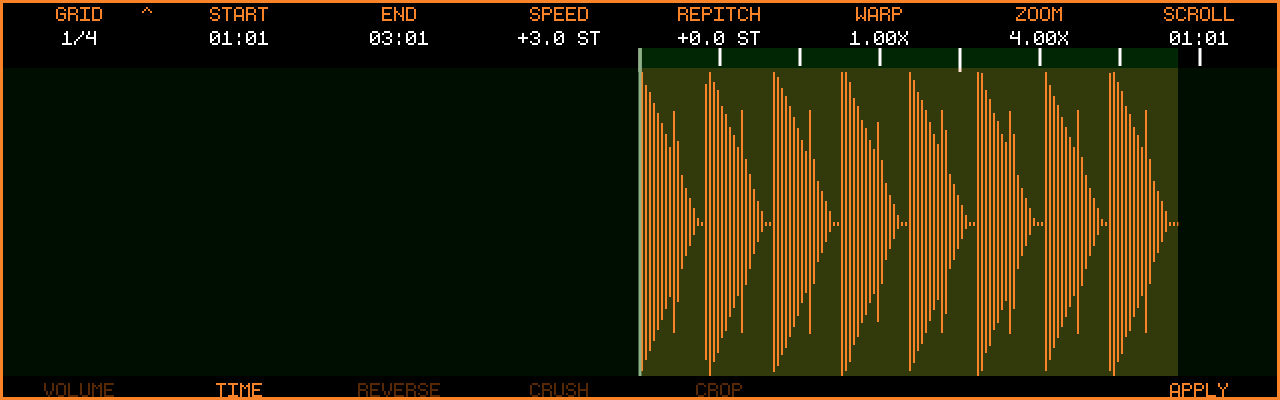
The Clipboard Modifier (introduced in v1.1.3) is a small self-contained editor that works on the audio clipboard instead of the tape. Copy audio, mangle it, audition it, then paste the result — the tape stays untouched until you paste.
The screen is marked with an orange border so it can’t be confused with the regular Audio Edit view.
Enter by touching the clipboard indicator on the Audio Overview or Audio Edit screen after a Cut/Copy
Or from Audio Edit: Track Button 6 CLIPMOD opens the modifier; + Track Button 6 COPY > CLIP copies the current selection and opens the modifier in one step (since v1.1.5)
Multi-track clipboards open with all copied tracks included — every edit is applied to all of them
Exit via any view button (e.g. or )
The modifier remembers the page and group you last worked in and reopens there (new in v1.2.1, pages (since v1.2.2)); all parameters start neutral on each visit
It also remembers the encoder 1 resolution — the GRID division, or JUMP mode and its millisecond step — so switching to the overview or wave edit screen and back no longer resets it to 1/4 (new in v1.2.1)
Important
Clipboard edits have no undo. If you don’t like a result, Copy the audio again for a fresh clipboard.
Hold and the first three encoders become the tuning settings that the SPRAY and RESO groups read. They are settings, not edits: they persist like GRID, have no APPLY, and turning them never discards a group’s un-applied changes. The pushes keep their normal jobs.
The groups are organised in pages (since v1.2.2). + Track Button 1–7 selects a page, Track Buttons 1–7 select a group on the current page, and Track Button 8 stays APPLY. While is held the track-button row shows the page names (the current page lit, the others muted, undefined pages blank); release it and the row shows the current page’s groups again. The current page is always shown at the top left of the waveform area, below GRID, as [EDIT], [GRAIN], [MOD] or [FX].
Each group puts its parameters on Encoders 4/5/6. Switching page or group (or re-pressing the current group) discards any un-applied settings of the current group.
+ Button
Page
Contents
1
EDIT
the original modifier: VOLUME … FILTER (CRUSH moved to DIST)
2
GRAIN
rhythmic granular resynthesis and a tuned resonator
3
MOD
LFOs printed over the region
4
FX
printed delay / reverb, loop tools
5
DIST
crush, colour, tape, amp, wavefolder, ring modulator
PAN: a balance on the clip’s existing stereo pair — panning right attenuates the left channel and leaves the right untouched (and vice versa). A clip recorded into one input only lives on one side, so panning it towards the silent side fades it out rather than moving it across.
FADE: negative values = fade-in, positive = fade-out. Values up to ±100 use an equal-power curve; beyond ±100 the curve gets steeper, up to ±200 (since v1.2.0)
SHUFFLE / STUTTER (since v1.2.2): while un-applied, the divisions are drawn over the waveform — thin lines with the source slice number for each SHUFFLE slice, dashed lines at each STUTTER repeat. Lines that would sit closer than a few pixels are left out; zoom in to see them
SPEED / WARP respect the 12-minute clipboard limit across all copied tracks combined — the encoder simply stops at the last value that still fits (new in v1.2.1)
Automation copied along with the clip follows a length change: after an APPLY that resizes the clip (SPEED, WARP, CROP), pasting places the automation over the new length rather than the original one
CROP needs no parameters: set START/END (or SLIDE the region), then APPLY to discard everything outside it (since v1.2.0)
PITCH bends the pitch smoothly from FROM at the region’s Start to TO at its End without changing the length (the same engine as REPITCH). A bend that resolves to the original pitch is TO = 0; one that drifts away is FROM = 0; FROM = TO is a static repitch. CURVE shapes the ramp: LIN is a straight line, positive values start slow and finish fast, negative values start fast and finish slow. Hold for 0.1 st steps
FILTER runs one filter node over the region and sweeps its cutoff from START to END (interpolated in octaves, so a sweep sounds even across the spectrum). START = END gives a static filter. The cutoff encoders step in thirds of an octave ( = a twelfth); push Encoder 6 to cycle the type LP → HP → BP. A low-pass with both ends at 20 kHz, or a high-pass with both at 20 Hz, is “open” and does nothing; cycling the type moves any open cutoff to the new type’s open end (1 kHz for BP, which has no open position)
A static setting in one press: pushing FROM / START copies the other end’s value onto it, pushing TO / END does the reverse — so dial a sweep, then push the end you want to keep and the whole region gets that value
While a PITCH or FILTER setting is un-applied, the sweep is traced as a line over the waveform (0 st on the centre line for PITCH; 20 Hz at the bottom to 20 kHz at the top for FILTER)
On a multi-track clipboard, APPLY shows its progress per track (“Track 3/8”) (new in v1.2.1)
Rhythmic granular resynthesis: the region is re-read as a stream of short grains on the musical grid.
Button
Group
Encoder 4
Encoder 5
Encoder 6
1
GRAIN
SIZE (grain length, note value 1/1–1/64)
RATE (grain onset interval, note value)
CONTOUR (-100 ramp down · SINE · +100 ramp up), push to toggle FOLLOW / HOLD
2
SPRAY (grains follow GRID)
POSITION (0–100 %, read-position scatter), push to re-roll
PITCH (0–100 %, chance of a scale-degree transposition)
REVERSE (0–100 %, chance of a backwards grain)
3
RESO
SLOPE (LP -100 · BP · HP +100)
DECAY (0–100, ring time)
MIX (0–100 %)
Notes:
GRAIN and SPRAY engage on the first encoder turn (there is no neutral grain setting); re-pressing the group button disarms them. With RATE shorter than SIZE the grains overlap into a dense texture, with RATE longer than SIZE they gate the region rhythmically. FOLLOW reads each grain where it sounds, so the arrangement is kept but re-articulated; HOLD reads every grain from the region start, freezing that instant into a sustained texture
SPRAY runs the same scheduler with grains one GRID step long, back to back (or one JUMP step in JUMP mode), and adds randomness per grain; change GRID on Encoder 1 to change the grain size. Transpositions are drawn from the SCALE / SPAN tuning settings, relative to the grain’s own pitch. The random pattern is fixed by a seed, so what you audition is what APPLY prints; push Encoder 4 for a new roll
While GRAIN or SPRAY is un-applied the grains are drawn over the waveform as window-shaped outlines on a dark backing, so they read over a waveform of the same colour: their width is SIZE, their spacing RATE, their shape CONTOUR. A transposed grain sits higher or lower (0 st on the centre line, like the PITCH line), a reversed grain shows its contour mirrored, and when a grain reads from somewhere other than where it sounds (POSITION, HOLD) a thin line leads to its read position at the bottom of the waveform
RESO is a bank of resonant filters tuned to the notes of SCALE across SPAN octaves above ROOT (at most 24 bands). The root sits in the centre and the following bands alternate left and right, so a chord spreads across the stereo field; the wet signal is lifted with DECAY and soft-clipped, so a narrow, long-ringing band comes out loud rather than thin. While un-applied the bank’s frequency response is drawn as a graph in a dark strip along the bottom of the waveform: one peak per band on a log frequency axis that spans the bank with an octave to spare on each side, DECAY narrowing the peaks, SLOPE growing a shelf on the side each band lets through, the root band’s note name under its peak (every band’s while there are few). The graph sits over the region while the region is wide enough, else across the whole screen. Fed a drum loop it produces a pitched, plucked version of the groove; fed a pad it rings as a chord. SLOPE morphs every band from low-pass through band-pass to high-pass, DECAY sets how long the bands ring. The ring-out continues past END into the rest of the clip (up to 6 s) and is cut at the clip end
One LFO per group, printed over the region. All four share the same encoder layout.
Button
Group
Encoder 4
Encoder 5
Encoder 6
1
VOL LFO (tremolo)
RATE (note value 1/1–1/64)
DEPTH (0–100 %)
SHAPE (SINE, TRI, SAW DN, SAW UP, SQUARE, S&H), push to advance the phase by 90°
2
PAN LFO (auto-pan)
RATE
DEPTH
SHAPE
3
PITCH LFO (vibrato, ±12 st at 100 %)
RATE
DEPTH
SHAPE
4
FILT LFO (auto-wah)
RATE
DEPTH (-100 to 100 %): positive closes a low-pass from 20 kHz by up to 8 octaves, negative opens a high-pass from 20 Hz by up to 8 octaves
SHAPE
Notes:
DEPTH 0 is neutral. Every shape starts unmodulated at the region’s Start: on VOL LFO and FILT LFO the wave dips from the top (SAW UP is the one swell that starts at the bottom); on PAN LFO and PITCH LFO it starts at the centre, SINE / TRI / SAW UP moving right / up first and SAW DN left / down first (SQUARE and S&H have no centre to start from and begin at the top). Pushing SHAPE advances the phase by 90°, so on PAN / PITCH one push starts at the peak, two at the centre falling, three at the trough. While a setting is un-applied the LFO is traced over the waveform at its actual DEPTH: VOL LFO as the gain from the top, PAN LFO and PITCH LFO around the centre line, FILT LFO as the cutoff on the filter scale (low-pass dipping from the top, high-pass rising from the bottom)
FILT LFO shows LP or HP in front of its DEPTH value so the sign is readable at a glance
A SQUARE on VOL LFO at 1/8 is a trance gate, a SAW DN at 1/4 a pump, S&H on PITCH LFO a random pitch pattern
DELAY / PINGPONG / REVERB are printed into the clip: inside the region MIX crossfades the dry signal with the effect, and the tail keeps running past END on top of the rest of the clip (up to 6 s, cut at the clip end). A printed tail can be reversed, granulated or resonated afterwards. The delay time is capped at 2 s
While un-applied, DELAY / PINGPONG mark each repeat above the waveform (fading with FEEDBACK; PINGPONG alternates top and bottom for left and right) and REVERB draws its decay envelope over the region: as tall as MIX at START, falling away over the tail’s length
ROTATE turns the region cyclically by grid steps (or JUMP steps in JUMP mode) so another beat lands on its start. XFADE smooths the loop seam: it blends the audio that follows END into the region’s start (or, when END is the clip end, the audio before START into the region’s end; with neither available it fades both ends). LAYER stacks the region onto itself every grid step, wrapping around the region, with a decaying level — a circular canon. While un-applied the waveform shows the result of all three tools (turned, seamed and stacked, exactly as APPLY will print it); a dashed line marks the ROTATE seam, XFADE draws its crossfade curves over the seam span, and LAYER marks each tap with a fading marker
Everything that bends the waveform itself. CRUSH (from the EDIT page) and COLOR (from the FX page) live here now.
Button
Group
Encoder 4
Encoder 5
Encoder 6
1
CRUSH
BIT (32 down to 1 bit)
SAMPLE (1x–32x rate reduction)
—
2
COLOR
DRIVE (0–100, tape saturation)
TILT (-100 drive the lows … +100 drive the highs)
COMP (0–100, one-knob compression), push to cycle the TILT crossover LOW (80 Hz) / MID (650 Hz) / HIGH (2.5 kHz)
3
TAPE
DRIVE (0–100)
DENSITY (0–100)
MIX (0–100 %)
4
AMP
GAIN (0–100, up to +30 dB), push to cycle the model CLEAN / CRUNCH / FUZZ / METAL
TONE (-100 dark … +100 bright)
CAB (0–100, speaker low-pass)
5
FOLD
FOLD (0–100)
SYMMETRY (-100 … +100)
SMOOTH (0 triangle … 100 sine)
6
RING
FREQ (20 Hz–2 kHz)
MIX (0–100 %)
WAVE (SINE / SQUARE / TRI)
Notes:
TAPE is the mastering tape saturator from the Master FX, printed into the clip, but let off the leash: DRIVE also pushes up to 12 dB of extra gain into the tape and above 50 blends in a second saturation pass, so DRIVE 100 is a fuzz rather than a polish. DENSITY is the tape’s thickness control, MIX blends the saturated signal with the dry one
AMP is a small amp chain: TONE shapes the sound before the stages (negative closes a low-pass, positive lifts the presence), GAIN drives the stages, CAB closes a 12 dB/octave speaker low-pass from fully open to 2.5 kHz. CLEAN is one soft stage, CRUNCH two asymmetric stages with a coupling filter between them, FUZZ a biased hard clip into a soft stage, METAL a tight high-pass into two hard stages with the mids scooped
FOLD is a wavefolder: FOLD drives the signal into the folder (up to 16x), SYMMETRY offsets it so even harmonics appear, SMOOTH morphs the folds from triangle (buzzy) to sine (round)
AMP and FOLD hold the level: their output is matched to the input’s envelope, so GAIN and FOLD add harmonics rather than volume and the result pastes back onto the tape at the level it was copied
RING multiplies the region with a carrier at FREQ: low carriers tremble, higher ones produce the metallic sidebands ring modulation is known for. FREQ steps in thirds of an octave ( = a twelfth). The carrier is locked to the region’s Start, so audition and APPLY sound the same
While a TAPE, AMP, FOLD or RING setting is un-applied the waveform shows the distorted result
plays the clipboard (not the tape), including all pending, un-applied settings — tweak while it plays
jumps the playhead to START without toggling playback (a running audition restarts from there). Pressed again while the playhead sits on START — or has just restarted from it — it jumps to the start of the clip, so two presses review the whole clip after editing a section (since v1.2.2)
/ move the playhead by the GRID / JUMP step
toggles looped playback
/ set the loop points to the playhead
Press + together to snap the loop to the current START/END region (new in v1.2.1)
Looped audition dips briefly (about 5 ms each side) through the loop point so the wrap never clicks; this is audition only — APPLY and the paste use the region exactly as it is (since v1.2.2)
Tape playback is silenced while the modifier is open; it resumes when you leave the screen