Settings & Projects
Press the Settings button to open the Settings screen (since v1.1.3 no SHIFT needed — SHIFT + Settings opens the USB Browser instead). Press Settings again to cycle to the Utility screen and back (new in v1.2.1).
Shortcuts from the Settings screen:
- Hold Settings + press Audio — open the Soundcard settings
- Hold Settings + press Midi — open the MIDI settings
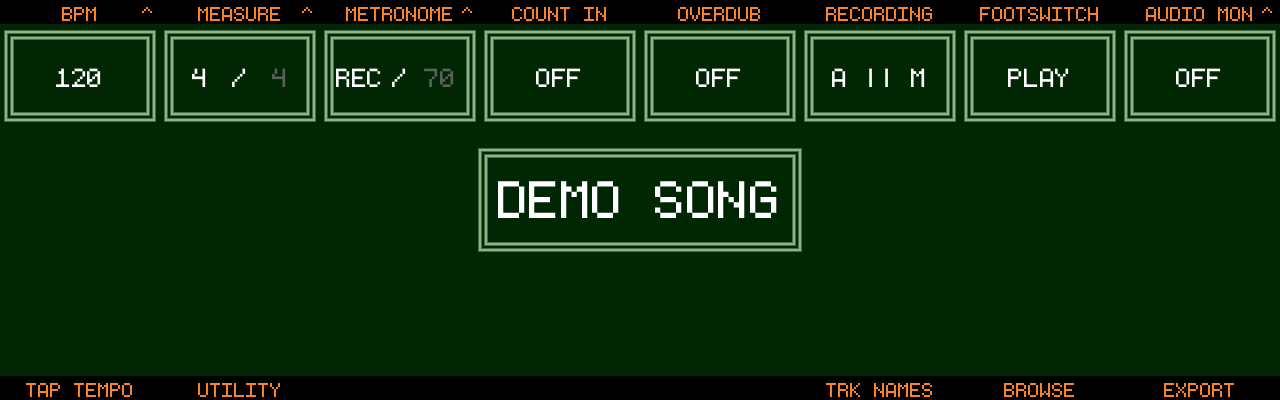
Project Settings
These settings are stored per project.
| Encoder | Setting | Values |
|---|---|---|
| 1 | BPM | 30–360. Push to switch between whole BPM and decimals (new in v1.2.1). Whole mode: SHIFT = steps of 10. Decimal mode: steps of 0.01, SHIFT = 0.1 |
| 2 | MEASURE | Time signature. Push to cycle numerator (1–32) / denominator (1–64, powers of 2) |
| 3 | METRONOME | OFF / REC (only while recording) / ON. Push to switch to the metronome level. Beats follow the time signature’s denominator — in 7/8 it clicks every eighth with the accent on 1 (fixed in v1.2.1) |
| 4 | COUNT IN | OFF or 1–16 beats, counted in the same beat as the metronome (7 beats = one bar of 7/8) |
| 5 | OVERDUB | ON / OFF |
| 6 | RECORDING | A && M records Audio and MIDI together, A || M records only the domain you are in |
| 7 | FOOTSWITCH | PLAY / RECORD / HOLD REC / TUNER / MARKER |
| 8 | AUDIO MON / MIDI MON | Push to cycle (MIDI MON new in v1.2.1). OFF / ON / PUNCH — PUNCH monitors only while the playhead is inside the punch brackets, whether or not punch recording is armed, so you can rehearse a punch-in and hear exactly what the recorded result will sound like (new in v1.2.1). Audio: switch OFF when using speakers and a microphone. MIDI: controls whether input is echoed to MIDI Out |
Track buttons:
- TAP TEMPO (Track 1) — tap at least twice to set the BPM
- UTILITY (Track 2) — open the Utility screen
- TRK NAMES (Track 6) — name your audio and MIDI tracks
- BROWSE (Track 7) — open the Project Browser (see below)
- EXPORT (Track 8) — export a mix or stems to USB, or bounce to a track
(since v1.2.0)
- Bouncing to a track overwrites that track’s audio from the insert point on — and a track is the default destination whenever no USB stick is plugged in. EXPORT therefore asks first: OVERWRITE (Track 6) goes ahead, Cancel (Track 3) leaves the track untouched (since v1.2.2)
- Confirmation dialogs — this one, the delete prompts, tape truncate — can also be answered by tapping the on-screen buttons, and every other control is locked until you answer (since v1.2.2)
Settings while recording
The Settings screen stays reachable during a take — that is how you toggle the metronome mid-pass. Controls that would break the recording (BPM, tap tempo, time signature, overdub, recording mode, and the doors to Utility / Track Names / Browse / Export) are refused with an on-screen error while a take is rolling (new in v1.2.1).
Project Browser
Open with BROWSE (Track 7) on the Settings screen.
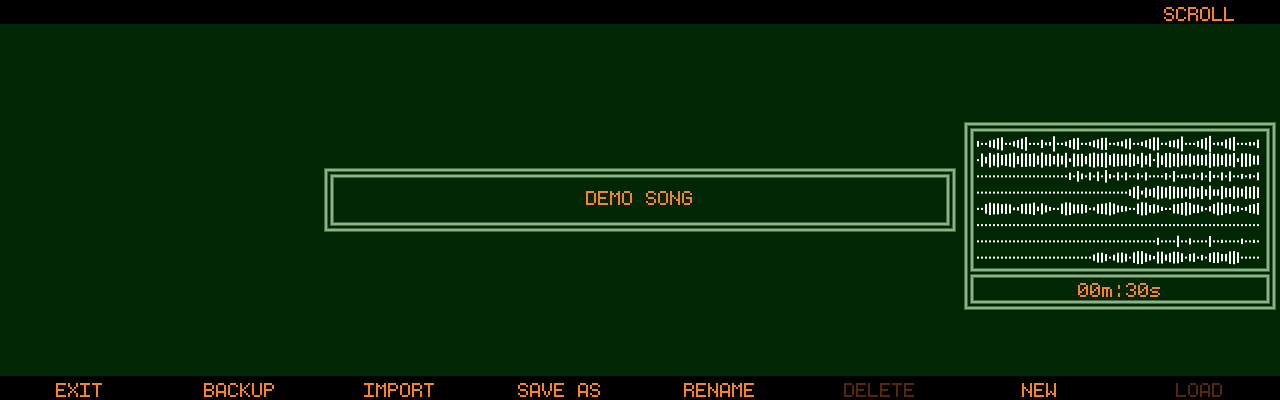
- Scroll projects with Encoder 8 — the selected project’s waveform loads as a preview. Projects are sorted alphanumerically (new in v1.2.1)
- LOAD (Track 8 or push Encoder 8) — switch to the selected project
- BACKUP (Track 2) — back up the selected project to a USB stick
- IMPORT (Track 3) — import a backup from a USB stick
- SAVE AS (Track 4) — save the current project under a new name
- RENAME (Track 5) — rename the selected project
- SHIFT + Track 6 — delete the selected project (the active project cannot be deleted; a confirmation dialog appears)
- NEW (Track 7) — create a new project; Encoder 1 on the name
keyboard picks a template (
TEMPLATE: ---= empty project)
Project Templates
(since v1.2.1)
A template is a project without content: it keeps the settings (BPM, time signature, metronome, record modes), track names and colours, MIDI channels, mixer levels / pans / mutes, Track FX, sends, Master FX and Mastering, external channel mapping and grid preferences — but no audio, MIDI, automation, markers, loop or punch. It also carries a setup: the audio interface configuration, MIDI sync settings, threshold record and tuner settings (channel names and device profiles stay as they are).

- Templates are listed at the bottom of the browser as
TEMPLATE: <name>(no waveform preview). With a template highlighted, LOAD turns into FROM TMP: enter a name for the new project (a random one is suggested) and it is created from the template - RENAME and
- The template’s setup is applied when the project is created. The active
audio interface itself is never switched automatically: if the template
was saved with a different interface, a hint asks you to select it in
UTILITY→AUDIO - Templates live in
templates/next toprojects/on the SSD

Projects load faster since v1.2.1: the waveform overview is cached with the project. The first load of an older project (or after editing its files outside Track8) rebuilds the cache and may take a moment longer.
You can also let Track8 ask for a new project on every start — see the
AT STARTUP setting in Utility (since v1.1.4).
Naming Things
Whenever a name is needed (projects, tracks, markers, exports) the input keyboard opens:
- Tap SHIFT on the keyboard for one uppercase letter; double-tap for Caps Lock, single tap to exit it (since v1.1.3)
- Left / Right buttons move the text cursor; the Record button deletes the character at the cursor (new in v1.2.1)
- When creating a new project, push Encoder 8 (dice) to generate a random project name (since v1.1.3)
- A standard USB keyboard can be used to type; only characters present on the touch keyboard are registered, and Enter confirms (new in v1.2.1)
- Names that end up on disk (projects, templates, backups, exports, saved
WAV / MIDI clips) cannot contain
/ \ : * ? " < > |— those keys are greyed out and ignored, and a name made only of dots cannot be confirmed (new in v1.2.1)